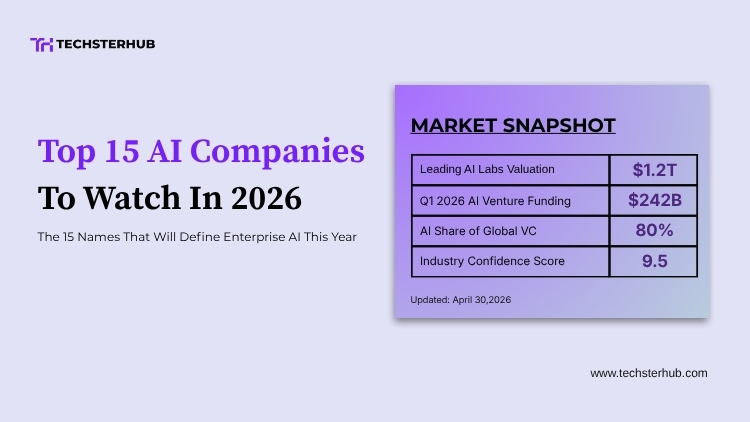
In Q1 2026, AI companies pulled in $242 billion in venture funding. That’s 80% of every dollar invested in startups globally. Four mega-rounds alone took $188 billion of it: OpenAI at $122B, Anthropic at $30B, xAI at $20B, and Waymo at $16B.
Raw funding tells you who’s hot, not who matters. This guide covers the top AI companies in 2026 that are actually moving the needle: what they ship, what they’re worth, and who should care. The AI companies to watch in 2026 span three distinct layers, and which layer matters to you depends entirely on what you’re building or buying.
The 2026 AI Power Map: Top AI Companies by Layer
The frontier AI labs, infrastructure providers, and vertical AI builders operate at very different levels. Understanding which layer you’re interacting with tells you more than any funding headline.
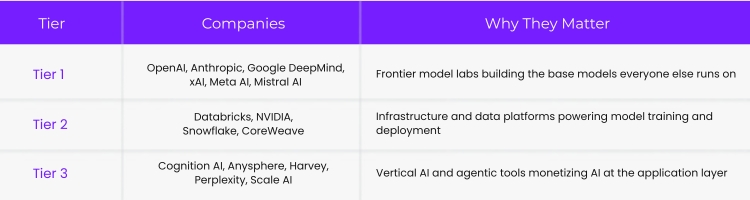
Valuations sourced from Crunchbase, PitchBook, and company filings, April 2026.
The Top 15 AI Companies and Leading AI Startups in 2026
1. OpenAI – Still the Default
OpenAI valuation: $852B (March 2026 round closed at $122B) | Revenue: ~$24B annualized | Q4 2026 IPO targeting ~$1T
OpenAI is still the most-used AI in the world: 900M+ weekly active users and over 1 million enterprise customers. ChatGPT is the verb. GPT-5.4 and Codex are the 2026 flagship releases. The distribution advantage from being the default consumer AI compounds every month.
The catch: Burn rate estimated at $17B for 2026. Governance restructuring is still unfolding. Anthropic and Google are closing the model quality gap faster than OpenAI’s brand lead would suggest.
2. Anthropic – The Enterprise Pick
Valuation: $380B (March 2026 Series G) | Revenue: ~$30B annualized run rate | Google committed up to $40B in funding (April 24, 2026).
Anthropic Claude became the clear enterprise choice in 2025 for tasks where accuracy matters more than speed. Anthropic Claude Code is the developer tool of 2026: 70 to 90% of new Anthropic code is now written by Claude Code itself, a recursive productivity advantage no other lab has matched. The MCP open protocol is shaping how AI agents integrate across enterprise tool stacks.
The catch: Heavy dependence on cloud partnerships for compute. Smaller consumer ecosystem than OpenAI. Brand recognition still trails in non-technical audiences.
3. Google DeepMind – Quietly Winning
Backing: Alphabet | Gemini Enterprise: 8M paid seats | Latest: Gemini 3 at frontier capabilities
Don’t sleep on Google. Gemini Enterprise hit 8 million paid seats in 2025. The training data advantage (YouTube, Search, and decades of behavioral data) is structural, and nobody else has it. Gemini 3’s multimodal architecture handles text, images, video, and audio in one system, which no other frontier lab matches at the same quality level.
The catch: Enterprise sales motion is still maturing compared to Anthropic and OpenAI. Slower product release cadence frustrates developers expecting OpenAI’s pace.
4. xAI – The Wild Card
Valuation: $200B+ (SpaceX joint IPO filing April 1, 2026, targeting $1.75T combined) | Latest: Grok 3 family, IPO filed April 2026
xAI Grok‘s model family improved fast through 2025, and tight integration with X gives real-time data access nobody else has. The IPO filing targeting a combined $1.75 trillion valuation with SpaceX would make it the largest tech IPO in history if successful. xAI Grok is the model; the compute infrastructure bet is the larger story.
The catch: All 11 original co-founders departed by March 27, 2026. Enterprise adoption beyond X is limited. Musk himself acknowledged the platform was not built right the first time.
5. Meta AI – The Open-Weights Bet
Backing: Meta Platforms | AI infrastructure spend: $30B+ in 2025-2026 | Latest: The Llama 4 family open-weight models
Meta’s strategic bet is simple and significant: keep AI open. Llama models stay open-weights, meaning any organization can download and run them inside their own infrastructure. For enterprises worried about vendor lock-in or data sovereignty, Llama is the primary alternative to proprietary models. Mistral is the only real open-weight competitor at frontier scale.
The catch: Reality Labs lost over $4B in Q1 2026. Pressure to monetize AI is rising. The open-weight strategy generates goodwill but not direct revenue.
6. Mistral AI – Europe’s Champion and One of the Best AI Startups 2026
Valuation: $14B (doubled from $6B in under a year) | Latest: Magistral reasoning model, ASML EUR’s €2B investment
Mistral is the best AI startup story of 2026 in Europe. ASML’s EUR 2B investment positioned Mistral as the EU’s answer to US model dominance. The regulatory advantage under the EU AI Act is real: Mistral’s governance architecture was designed for European compliance from the start. Customer base spans Orange, BNP Paribas, Renault, Deutsche Telekom, and the European Commission.
The catch: US market penetration remains limited. Compute access still trails US-based labs. Scaling globally requires resources that European VC markets have not yet provided.
7. Databricks – The Infrastructure Giant
Valuation: $134B (December 2025) | Revenue: $5.4B ARR | Databricks IPO: H2 2026 planned
Databricks is the largest data and AI platform in the world, with 20,000+ customers, including the NBA, AT&T, Shell, and government agencies. The lakehouse architecture remains the standard for enterprise data engineering plus ML. The Databricks IPO in H2 2026 will set the benchmark multiple for every AI SaaS listing that follows: its pricing matters for the entire category.
The catch: Anthropic’s software productivity improvements in early 2026 raised questions about AI disrupting the data engineering workflows that are Databricks’ core market. The IPO roadshow will need answers.
8. NVIDIA – The Picks-and-Shovels Winner
Data center revenue: $47.5B in fiscal year 2024 | Total revenue: $60.9B (up 122% YoY)
You don’t get AI without NVIDIA chips. The H100, H200, and Blackwell GPUs power nearly every frontier model trained in 2025 and 2026. Every dollar spent training AI models flows through NVIDIA somewhere in the stack, especially those built on advanced AI Foundation Models. NVIDIA AI Enterprise and NIM microservices have moved the company up from chips to platform, adding a recurring software revenue layer on top of hardware.
The catch: OpenAI’s move toward Cerebras chips signals real hardware competition starting. Custom silicon from Google (TPU), AWS (Trainium), and Microsoft (Maia) is a long-term structural threat.
9. Snowflake – AI Inside the Data Cloud
Latest: Cortex AI, NVIDIA partnership (November 2025), 300-cluster support
Snowflake quietly transformed from a data warehouse into a credible AI platform in 2025. Cortex AI runs LLM functions directly from SQL: summarization, classification, extraction, and natural-language queries all run on Snowflake data without moving it to an external system. For enterprises with data already in Snowflake, this is the simplest path to production AI available in 2026.
The catch: Cortex AI only works with data in Snowflake. Fragmented data stacks that live across multiple platforms need Databricks or a cloud-native AI platform instead.
10. CoreWeave – The AI-Native Cloud
Status: Public (IPO’d March 2025, ticker CRWV) | Stock price: ~$90 (April 2026)
CoreWeave is purpose-built AI cloud infrastructure: GPU clusters optimized for training and serving large models, positioned as the effective fourth hyperscale alongside AWS, Azure, and GCP. When OpenAI, Anthropic, and Mistral need compute capacity beyond their primary cloud partners, CoreWeave is increasingly the overflow provider.
The catch: Concentrated customer base. If a top customer pulls capacity, revenue takes a significant hit. Public market scrutiny will be sharper than it was as a private company.
11. Cognition AI – The Coding Agent Pioneer
Notable: Built Devin, the first credible autonomous AI software engineer
Cognition built Devin in 2024, the first AI coding agent that could autonomously plan, execute, and debug multi-file software projects. By 2026, the AI coding market is multi-billion and accelerating. Cognition is competing against Anthropic Claude Code, Anysphere Cursor, GitHub Copilot, and OpenAI Codex in the fastest-growing software category in history.
The catch: Differentiation becomes harder every month as frontier labs push more deeply into the coding agent market with better base models.
12. Anysphere (Cursor) – The Developer’s Daily Tool
Product: Cursor AI-first IDE | Revenue: $2B run rate by early 2026
Cursor is the AI-first code editor that became the developer tool of 2026 alongside Anthropic’s Claude Code. By early 2026, it had reached a $2B revenue run-rate, extraordinary for a 3-year-old company. Where developers spend their time is where the next platform layer gets built, which makes Anysphere’s distribution advantage more valuable than its revenue suggests.
The catch: Key engineers, including the founders who scaled Cursor, were poached by xAI in March 2026. Talent retention defines the next 12 months.
13. Harvey – Vertical AI for Legal
Customers: Top 100 global law firms | Position: Default AI platform for legal work
Harvey is the vertical AI success story that validates the entire category. Built specifically for legal workflows (contract review, research, document drafting), it is now the default AI platform at most top global law firms. It proves that specialized AI companies in legal, healthcare, and finance can raise at enterprise software multiples even in a market dominated by frontier labs.
The catch: Foundation model labs keep pushing into specialized verticals. Defending the moat requires constant deepening of legal-specific workflows that generic AI cannot easily replicate.
14. Perplexity – The Answer Engine
Valuation: High teens of billions (mid-2025) | Revenue: Materially above an $80M run-rate from the end of 2024
Perplexity is the AI-native answer engine: live citations, follow-up questions, real-time web access, and a genuinely useful research experience. It is reshaping how people search in a way that both ChatGPT Search and Google’s AI Overviews are scrambling to match. The SEO implications for content publishers are significant and still unfolding.
The catch: Operating in Google’s shadow. Distribution is hard without a browser deal. The Apple and Samsung negotiations are critical to the next phase of growth.
15. Scale AI – Training Data Infrastructure
Valuation: $14B (June 2025) | Total funding: $15.9B | Projected revenue: $2B by year-end 2026
Scale AI is the training data backbone that most people outside the AI industry have never heard of. OpenAI, Google, Meta, and Anthropic all use Scale’s data labeling and evaluation services to improve their models. It is the picks-and-shovels business of frontier model training: as long as labs keep raising billions to build better models, Scale keeps making revenue.
The catch: Customer concentration risk. A handful of frontier labs likely make up most of the revenue. If one major lab brings data operations in-house, the impact is significant.
5 Trends Behind the Top AI Companies in 2026
The top AI companies in 2026 all moved into position because of these five structural shifts. Understanding them is more useful than tracking individual funding rounds. These same trends explain which of the best AI startups of 2026 are likely to matter in 2027.
- AI coding became a category. Anthropic Claude Code, Anysphere Cursor, and Cognition Devin are the fastest-growing software companies ever. Coding is where AI gets monetized first.
- The IPO window opened. SpaceX (June), Databricks (H2), OpenAI (Q4), Cerebras (Q2). Markets must absorb $2.9T+ in combined float, historic for any single year.
- Vertical AI works. Harvey for legal and Abridge for healthcare. Foundation models are getting commoditized at the base layer. Specialized AI is the new defensible moat.
- Compute is the bottleneck. Anthropic took $40B from Google partly to secure compute. xAI’s IPO valuation is partly an infrastructure bet. Without GPUs you don’t ship frontier models.
- Open-weights matter. Meta (Llama 4) and Mistral are proving that enterprises will pay for AI they can run inside their own infrastructure. The bet is paying off.
What This Means for B2B Decision Makers
If you’re not building AI but you have to make decisions about it, three principles apply regardless of which specific companies end up on next quarter’s list.
- Buy from the top tier when model quality determines outcomes. OpenAI, Anthropic, and Google for frontier capability. Don’t save money on the layer that drives accuracy.
- Use open weights when control matters more than capability. Mistral or Llama 4 if data sovereignty, cost predictability, or full audit trails are non-negotiable.
Pick infrastructure based on where your data already lives. Databricks, Snowflake, and the hyperscale platforms each have a clear home base. The right choice is almost always whatever runs next to your existing data.
Final Word
The top AI companies in 2026 will keep getting reshuffled through the rest of the year. New labs will emerge. Some on this list will stumble. The IPO window will close, then reopen. Funding headlines will be bigger and smaller in the same week.
|
The structure of the AI economy is set: frontier labs build the models, infrastructure companies run them, and vertical AI companies monetize them. Knowing who sits in each layer, what they ship, and who should care is now a baseline skill for anyone making technology decisions in 2026. |
If you’re a B2B decision-maker, pick one company per layer to track closely. One frontier lab. One infrastructure platform. One vertical AI for your industry. Three names are enough to stay current. Fifteen is too many.
FAQs: