Anthropic hit a $30 billion annualized revenue run-rate by April 2026. Google committed up to $40 billion in funding (April 24, 2026). Claude Code revenue alone reached a $2.5 billion run rate. The $380 billion valuation makes Anthropic the second-most-valuable AI company in the world.
But valuations do not matter to procurement teams. Should your organization deploy Claude for Enterprise, or are you better served by ChatGPT Enterprise, Microsoft Copilot, or Google Gemini Enterprise?
This Anthropic Claude review 2026 short answer: Claude is the best frontier AI for accuracy-critical work, especially software engineering. The recent shift to usage-based pricing reduces predictability but eliminates wasted seat fees for light users. For knowledge work and code, Claude wins on quality. For consumer-style integrations and image generation, ChatGPT and Gemini still lead.
Quick Verdict
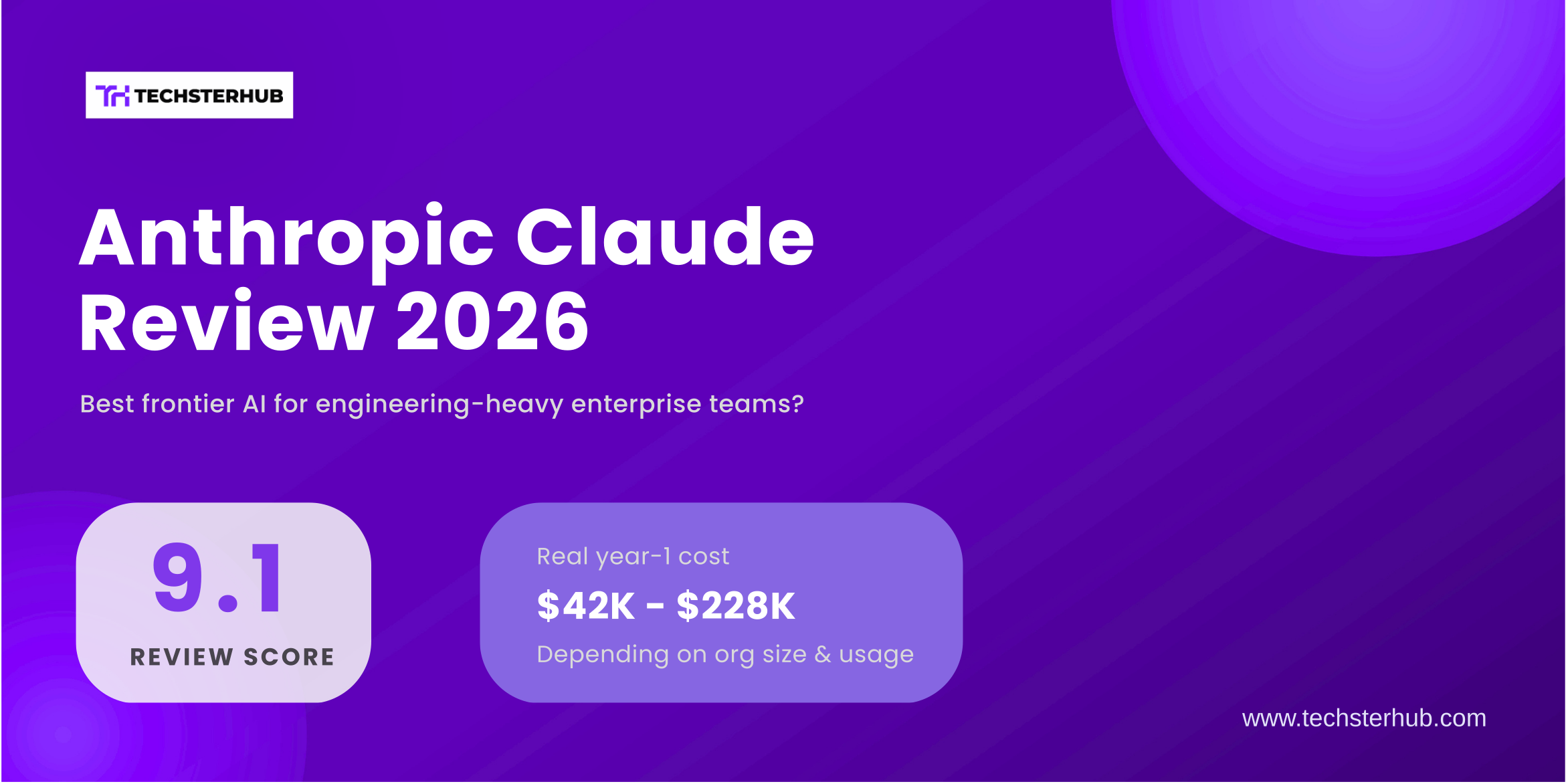
| Score: 9.1 / 10 | Best for engineering-heavy organizations, accuracy-critical knowledge work (legal, finance, and healthcare), and teams already using Claude Code at scale.
Real Year-1 cost: $20/seat/month base + token consumption. 100-person engineering org: ~$228,000. 50-person knowledge org: ~$42,000. Skip if you need extensive third-party integrations, image generation, or predictable flat-rate pricing. |
What Is Claude for Enterprise?
Claude for Enterprise is Anthropic’s organizational tier. As of February 2026, Anthropic consolidated previous tiers into a single all-inclusive enterprise seat covering chat, Claude Code, and Anthropic Cowork at $20/user/month plus usage-based token consumption.
The platform spans four products: Claude (chat via web, desktop, mobile, and MCP-enabled integrations), Claude Code (agentic coding from the command line), Anthropic Cowork (desktop automation for non-developers), and the Claude API (programmatic access via Anthropic, AWS Bedrock, Google Vertex AI, and Microsoft Foundry).
The 2026 model lineup:
- Claude Opus 4.7: Frontier, the highest capability
- Claude Opus 4.6: Previous flagship, still widely deployed
- Claude Sonnet 4.6: Balanced cost-capability sweet spot, most common enterprise deployment
- Claude Haiku 4.5: Fastest, lowest cost per token
Anthropic Claude Review 2026: Pricing Breakdown & Usage-Based Shift
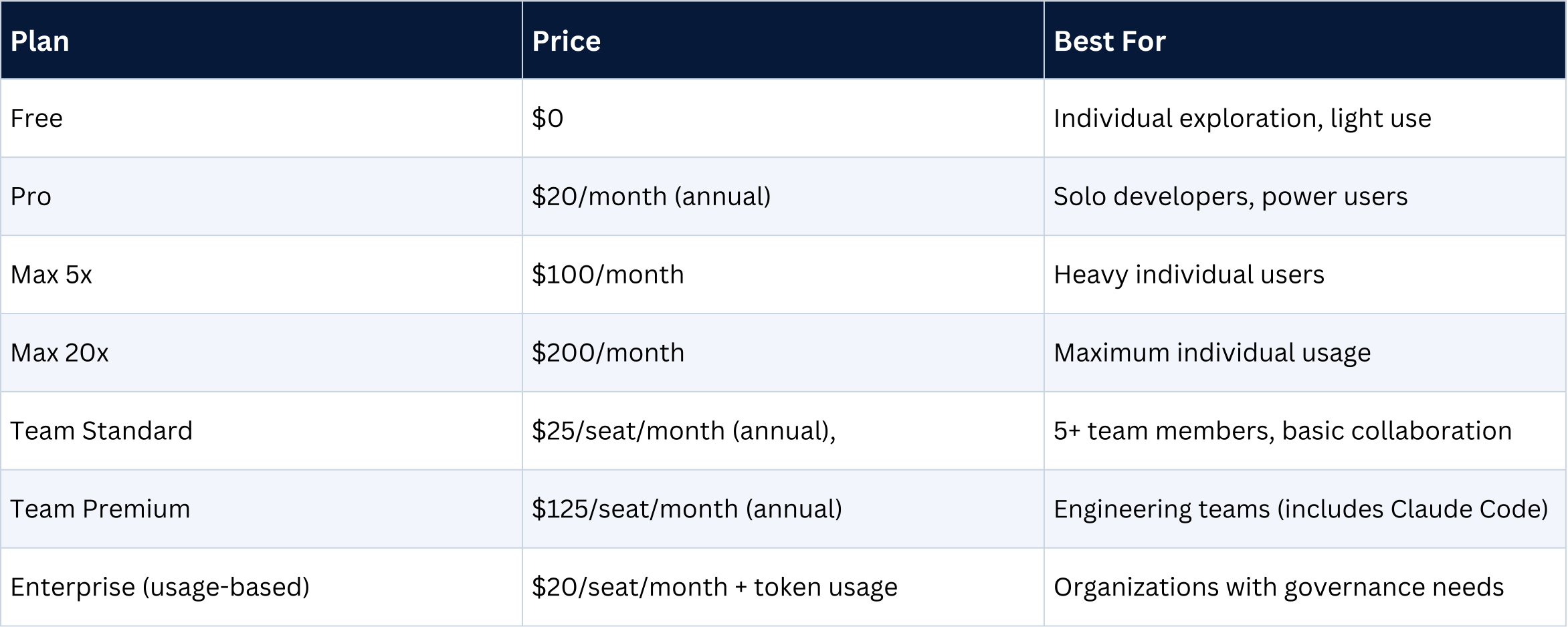
This Anthropic Claude review 2026 covers the February 2026 pricing model change in full. Claude for Enterprise pricing shifted from fixed per-seat tiers to a $20/seat base plus usage-based token consumption. Here is what that means in practice.
The Enterprise Usage-Based Model
The new Claude for Enterprise pricing model works as follows:
- Base seat fee: $20/user/month covers chat, Claude Code, and Anthropic Cowork access.
- Token usage: Billed at standard API rates from a shared organizational pool.
- No usage caps: Heavy users do not hit walls; light users do not waste budget on unused seat fees.
- Spend controls: Admins set spend limits at the organization or user level.
Real Annual Costs
For a 100-person engineering organization:
- 100 seats x $20/month x 12 = $24,000 (base)
- 80 developers x $200/month average x 12 = $192,000 (developer token usage)
- 20 non-developers x $50/month average x 12 = $12,000 (non-developer usage)
Real Year-1 cost for a 100-person engineering org: ~$228,000
For a 50-person knowledge-work organization:
- 50 seats x $20 x 12 = $12,000 (base)
- 50 users x $50/month average x 12 = $30,000 (usage)
Real Year-1 cost for a 50-person knowledge org: ~$42,000
What Changed in 2026
A key finding from this Anthropic Claude Review 2026 is that Anthropic’s shift toward usage-based pricing significantly changes enterprise budgeting.
- Single Enterprise seat (Feb 2026): Replaced legacy chat-only and split Claude Code tiers.
- Usage-based billing: Removed the $40-$200/month per-seat legacy tiers.
- Legacy API discounts removed: The 10-15% volume discounts that softened per-token costs are gone.
- Long-context surcharge eliminated (March 13, 2026): A 900K-token request now costs the same per-token rate as a 9K-token request on Claude Sonnet 4.6 and Opus 4.7.
Hidden Cost Considerations
Every Anthropic Claude review in 2026 should evaluate hidden costs because enterprise AI pricing rarely ends with seat licenses.
- Mandatory consumption commitments: Anthropic may require pre-committed spending. You pay the committed amount even if usage is lower.
- No volume discounts: Legacy enterprise discounts (10-15% per-token reduction) are removed.
- Regional endpoint premium: Regional endpoints on AWS Bedrock and Vertex AI carry a 10% premium for data residency.
- US-only inference premium: US-only inference is 1.1x standard pricing for input and output tokens.
- Mandatory consumption commitments: Anthropic may require pre-committed spending. You pay the committed amount even if usage is lower.
What This Anthropic Claude Review 2026 Finds Genuinely Good
1. Frontier Model Quality
Claude is the preferred frontier model for accuracy-critical work in 2026. Software engineering benchmarks consistently rank Opus 4.7 and Claude Sonnet 4.6 at the top of practical coding tasks. Long-form reasoning, document analysis, and structured output quality are Claude’s strongest dimensions. For legal contract review, financial analysis, medical literature synthesis, and regulatory compliance documentation, Claude is the most-deployed enterprise AI in 2026.
2. Claude Code
Anthropic reports 70 to 90% of new internal code is now written by Claude Code. Weekly active users doubled between January and February 2026. Average enterprise spend runs $13/developer/active day, or $150 to $250/developer/month. 90% of users stay below $30/active day.
Claude Code operates from the command line as a genuinely agentic coding tool: it reads codebases, writes code, runs tests, and ships changes with minimal human intervention. For engineering organizations, this Claude Code review finding is clear: it is the highest-leverage AI deployment available in 2026.
3. Privacy and Data Use Posture
No paid tier trains on customer data by default. Team and enterprise plans include contractual guarantees for enterprise privacy. Backed by its public benefit corporation structure, Claude is well-suited for regulated industries such as finance, healthcare, legal, and government. Anthropic is also strengthening its global enterprise strategy through its Anthropic EMEA expansion, highlighting its growing commitment to customers across Europe.
4. 1M Token Context Window (No Surcharge)
Claude supports up to 1 million tokens of context with no per-token surcharge for long inputs as of March 13, 2026. On Claude Opus 4.6, Claude Sonnet 4.6, and Opus 4.7, a 900K-token request costs the same per-token rate as a 9K-token request. This makes Claude particularly strong for large codebase analysis, multi-document research, and comprehensive legal document review.
5. Multi-Cloud Availability and MCP Standard
Claude is available on AWS Bedrock, Google Vertex AI, and Microsoft Foundry. Enterprises choose deployment based on existing cloud with consistent model access across providers. Anthropic’s MCP open protocol is reshaping enterprise AI tool integration: by 2026, MCP has gained adoption beyond Anthropic as a de facto standard for connecting AI tools to enterprise data.
Where Claude for Enterprise Falls Short
- Pricing predictability. Usage-based billing removes wasted seat fees but eliminates the predictability CFOs and procurement teams expect from enterprise contracts. Mandatory consumption commits add another layer of forecasting complexity.
- No image generation. Claude does not generate images. For teams with visual content workflows, this is a genuine gap. ChatGPT (DALL-E 3), Gemini (Imagen 3), and Microsoft Copilot all generate images natively.
- Smaller third-party ecosystem. OpenAI’s GPT Store and ChatGPT Enterprise have a larger third-party plugin ecosystem. Microsoft Copilot has deeper Microsoft 365 integration. Claude’s ecosystem is growing fast via MCP but trails in breadth in 2026.
- Token cost premium. Claude API token rates run roughly 2 to 2.5x higher than comparable OpenAI and Google offerings. For high-volume use cases where model quality differences are marginal, this premium is hard to justify.
- April 2026 model quality concerns. Public complaints surfaced about performance degradation, particularly around Claude Code. Anthropic addressed this directly with changelog notes. The issue appears resolved, but the perception lingered for some users.
Claude for Enterprise vs. Alternatives in 2026
The Claude vs. ChatGPT enterprise comparison drives most frontier AI evaluations. This Anthropic Claude Review 2026 addresses it alongside all primary alternatives:
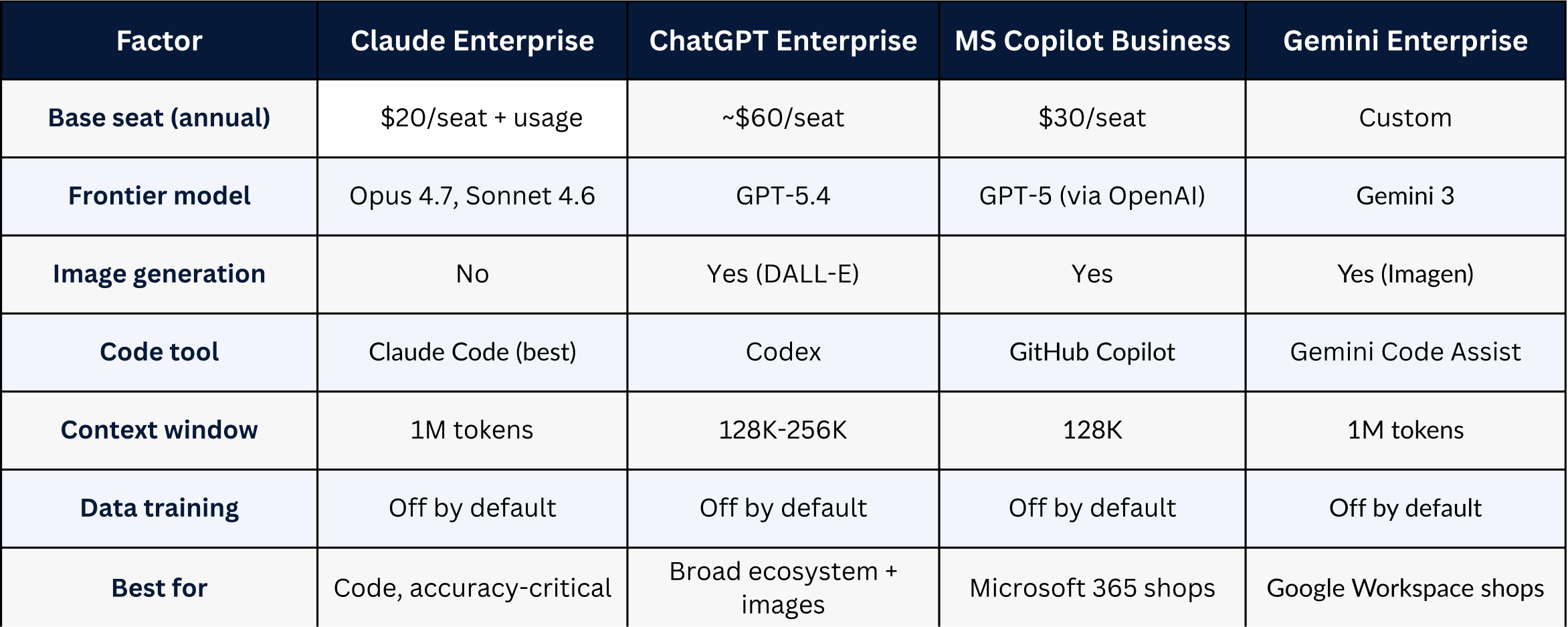
On Claude vs. ChatGPT Enterprise: for software engineering and accuracy-critical knowledge work, Claude wins. For a broad third-party ecosystem, image generation, and consumer familiarity, ChatGPT Enterprise wins. Many enterprises deploy both for different use cases. Claude Code versus GitHub Copilot is the most practically significant comparison for engineering teams: Claude Code is agentic and autonomous; GitHub Copilot is in-editor pair programming.
Who Should Buy Claude for Enterprise in 2026
Buy if: Engineering-heavy organization where Claude Code is the primary deployment. Accuracy matters more than speed (legal, finance, healthcare, and regulated industries). Need 1M token context for large codebase or document workloads. The team values the no-training-by-default contractual guarantee. Already using Claude on AWS Bedrock or Vertex AI.
Skip if: Need predictable flat-rate pricing. Image generation is a meaningful workflow requirement. Heavily invested in Microsoft 365 (Copilot is more native). Heavily invested in Google Workspace (Gemini Enterprise is more native). Need the largest third-party plugin ecosystem (ChatGPT Enterprise wins).
Final Verdict: Anthropic Claude Review 2026
This Anthropic Claude review 2026 conclusion: Claude is the strongest frontier AI for accuracy-critical work and software engineering. The model quality, Claude Code dominance, privacy posture, and 1M token context add up to a platform that genuinely improves how enterprises do knowledge work and ship code.
For Microsoft-aligned organizations: Copilot will be more native and easier to deploy. For Google Workspace organizations: Gemini Enterprise is the path of least resistance. For organizations needing image generation or the largest third-party ecosystem: ChatGPT Enterprise is the practical choice.
For everyone else (engineering-heavy organizations, accuracy-critical industries, teams already using Claude Code at scale): Claude is the right answer in 2026. The usage-based pricing rewards heavy users and eliminates waste, even if it requires more sophisticated budgeting than legacy flat-rate enterprise contracts.
Score: 9.1 / 10 | Buy if your team is code-heavy or accuracy-driven. Skip if you need image generation or predictable flat pricing.