ChatGPT Enterprise pricing is not on OpenAI’s website. The pricing page shows ChatGPT Business at a fixed seat price and lists Enterprise as “contact sales”. Many articles fill that gap with a per-seat figure they cannot trace to OpenAI.
This guide sticks to what OpenAI documents. Under its flexible pricing model, an Enterprise contract has two parts: seats, and a shared pool of credits for advanced features. Understanding the credit side is what lets you size a deal and compare it fairly with Business or other enterprise assistants.
| Quick answer: ChatGPT Enterprise pricing is custom, negotiated with OpenAI sales, with volume discounts and invoicing. A contract combines seats with a shared credit pool used by advanced features such as deep research, thinking models, agent mode, image generation and Codex. Everyday chat on the instant model does not use credits. OpenAI does not publish the Enterprise seat price or the dollar value of a credit. For comparison, ChatGPT Business costs $20 per user a month billed annually, or $25 monthly, with a two-user minimum. |
How ChatGPT Enterprise pricing works
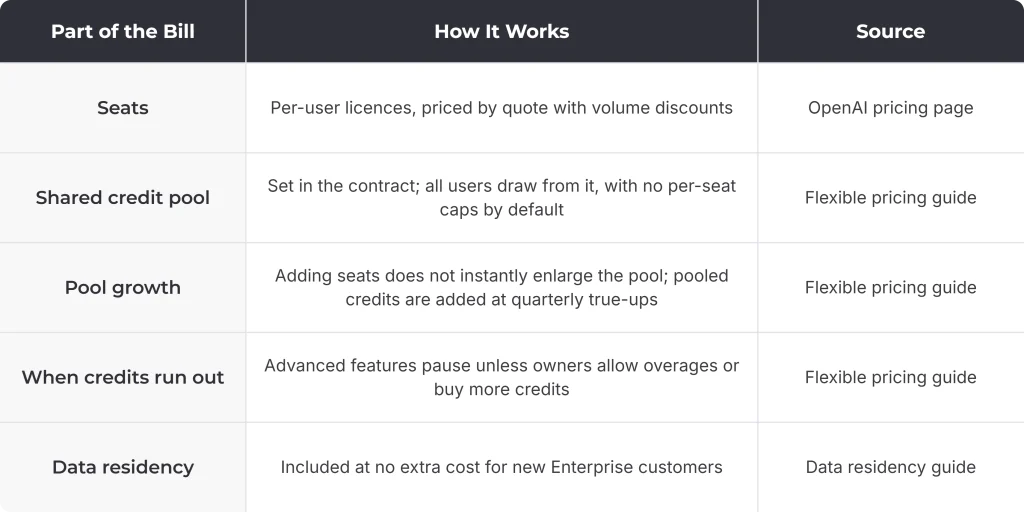
The practical point of ChatGPT Enterprise pricing: two companies with the same number of seats can pay very different amounts, because heavy users of deep research and Codex draw far more from the pool than everyday chat users.
The ChatGPT Enterprise credit rate card
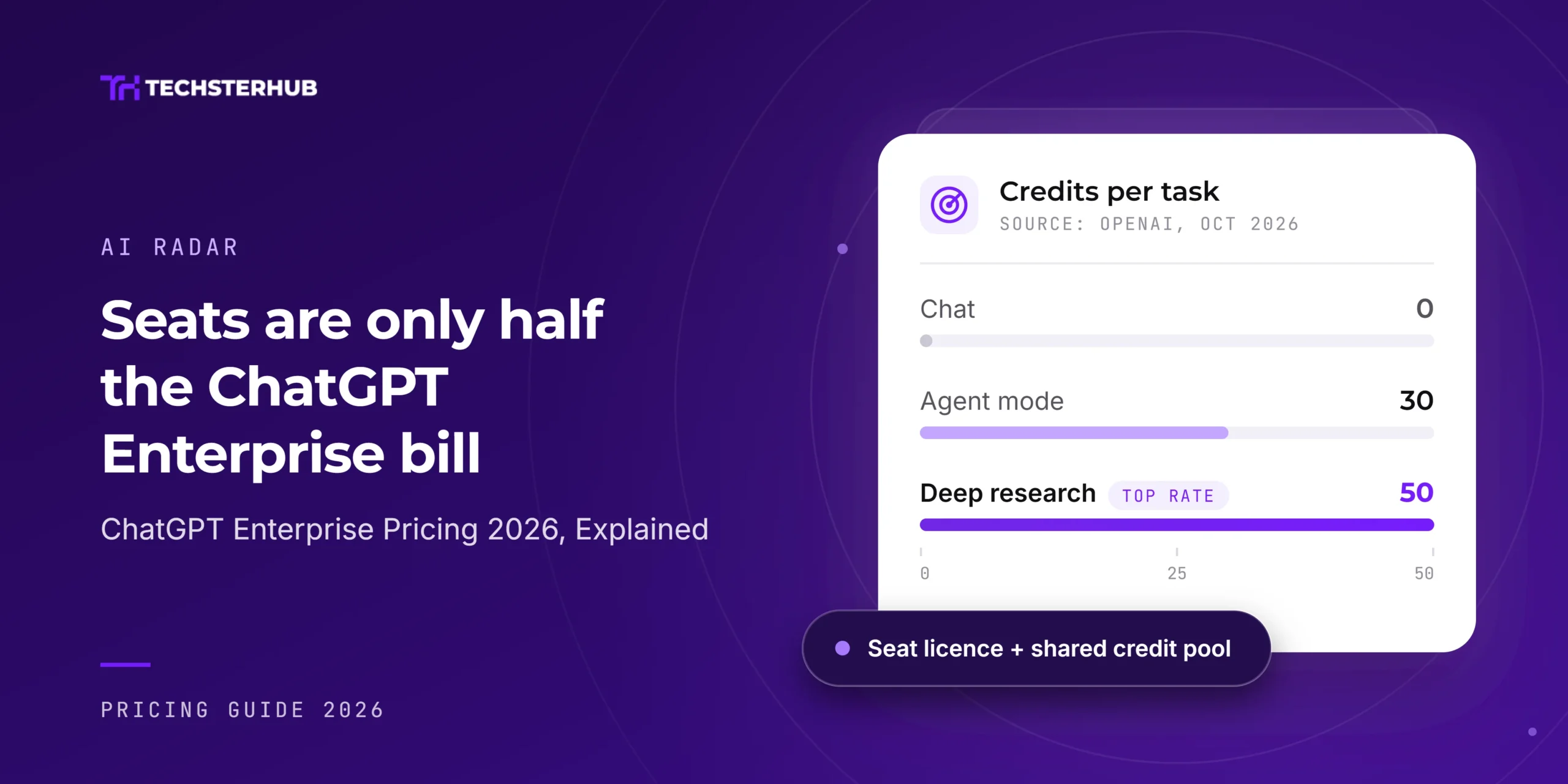
OpenAI’s flexible pricing guide sets how many credits each advanced action uses. Checked on 15 October 2026:
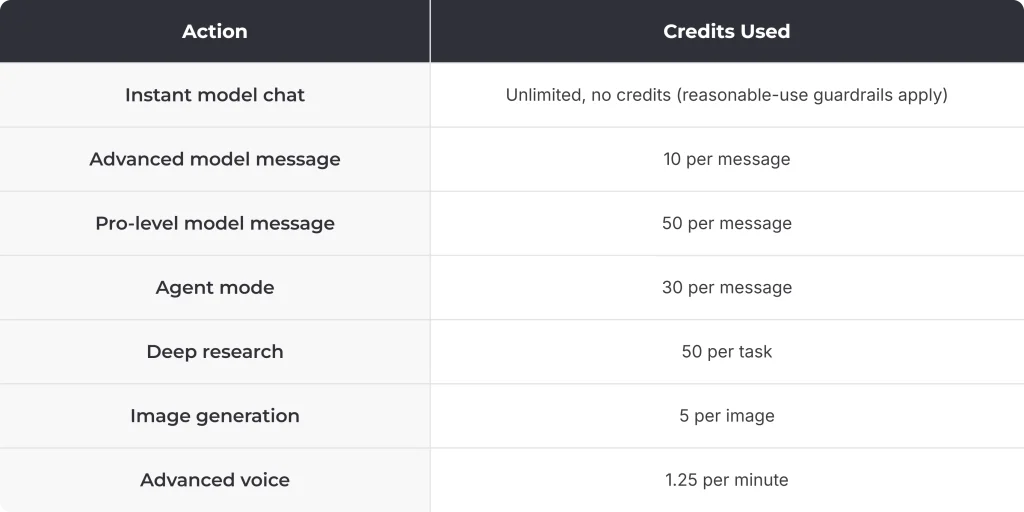
Search, file upload and canvas do not use credits, and messages automatically routed to a smaller model do not either. Credit rates are the moving part of ChatGPT Enterprise pricing, so confirm the current card in your contract.
Estimate your credit pool before you talk to sales
Use the rate card to turn a pilot into a monthly credit estimate. A worked example for a single research-heavy user, for illustration:
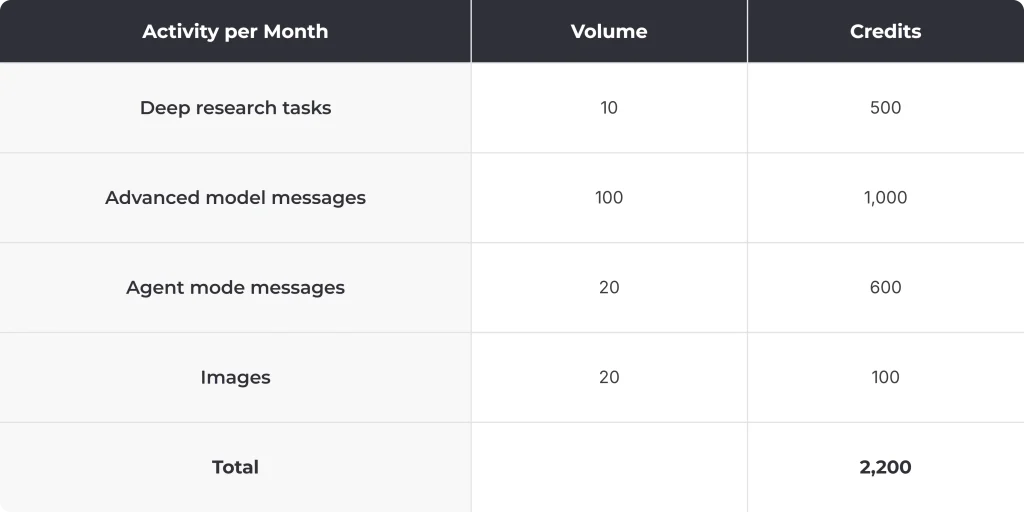
| Pool formula: Monthly credits = sum of (actions per user × credits per action) for each user group. Size the pool from the groups that use advanced features, not from total seat count, then add a buffer for growth until the next quarterly true-up. |
Run the estimate separately for research teams, engineering teams using Codex, and everyday users. Most of the pool usually goes to the first two.
ChatGPT Enterprise vs Business: what the extra cost buys
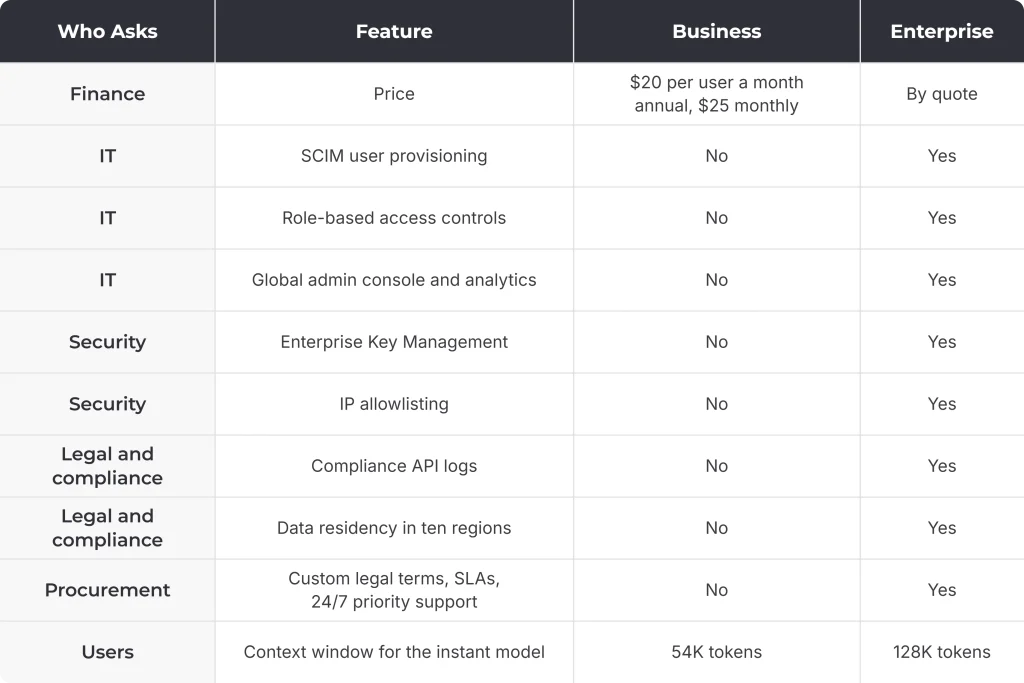
For a team of 20 with no residency or audit needs, Business at a fixed seat price is usually enough. Once identity, data location or audit requirements appear in a security review, Business is no longer an option, and the comparison becomes Enterprise against other enterprise assistants.
ChatGPT Enterprise vs Claude, Gemini and Copilot on price
Here is what each vendor states on its own pricing or plan pages, checked in October 2026. “Ask” means we did not find it stated there, not that it is missing.
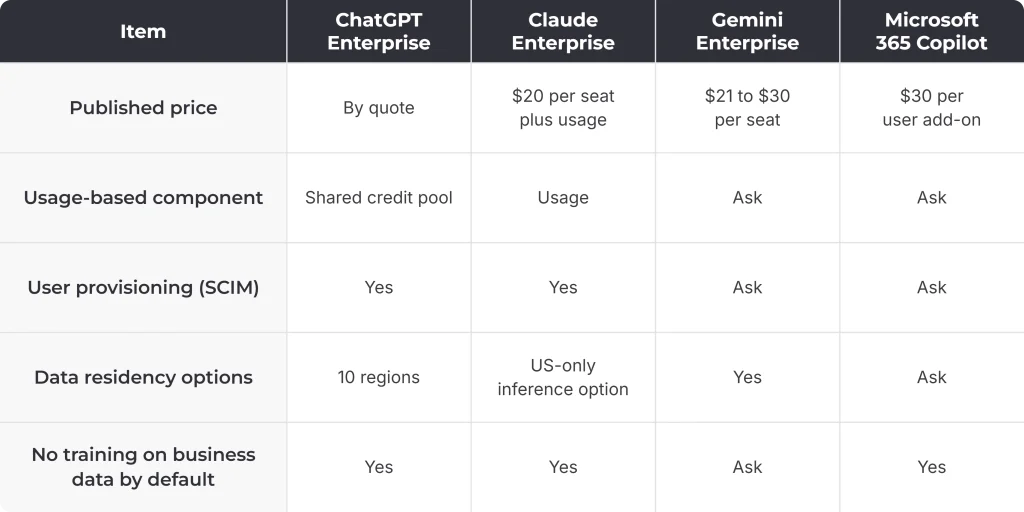
Compare total annual cost for the same users and workloads, not headline seat prices. Our comparison of enterprise AI assistants by use case and our Anthropic Claude review cover the alternatives in depth.
What the Enterprise price includes beyond the model
- Identity: SSO, SCIM provisioning and custom roles, with group changes in your identity provider updating ChatGPT access.
- Logging: the Compliance API gives security and compliance tools access to workspace logs, and OpenAI’s release notes show it expanding to library files and Codex policy changes.
- Data location: residency for storage at rest in ten regions (Australia, Canada, Europe, India, Japan, Singapore, South Korea, the UAE, the UK and the US), and inference residency in Europe, the US and the UAE.
- Encryption and retention: Enterprise Key Management and custom retention policies. OpenAI states that business data is not used for training by default.
- Spend controls: admins can set credit limits by workspace, group or user.
Read the residency exclusions before promising anything to a regulator. External integrations, transient processing, workspace metadata, billing and logins can be processed outside the region, and some features, including Codex Web and third-party GPTs, are not supported in residency-enabled workspaces.
How to negotiate ChatGPT Enterprise pricing
- Run a 30-day pilot with three to five teams and measure credit use by group.
- Negotiate seats and the credit pool together. A low seat price with a small pool can cost more later.
- Ask how overages are priced and whether they are on or off by default.
- Ask when pooled credits are added for new seats, given quarterly true-ups.
- Get the credit rate card attached to the contract, since rates can change.
- Bring a competing quote for the same users from another enterprise assistant.
For the policy side of rollout, see our AI governance framework.
FAQs:
How much does ChatGPT Enterprise cost per user?
OpenAI does not publish a per-user price for ChatGPT Enterprise. Seats are priced by quote with volume discounts, alongside a shared credit pool.
How much does ChatGPT Business cost?
ChatGPT Business costs $20 per user a month billed annually, or $25 billed monthly, with a minimum of two users.
What uses ChatGPT Enterprise credits?
Advanced features such as deep research, thinking and pro-level models, agent mode, image generation, advanced voice and Codex. Instant model chat, search and file upload do not.
How many credits does deep research use?
OpenAI’s rate card lists deep research at 50 credits per task, checked 15 October 2026.
What happens when the credit pool runs out?
Advanced features pause unless workspace owners allow overages or buy more credits. Everyday chat keeps working.
Is ChatGPT Enterprise worth it for small teams?
Usually not. Small teams without residency, audit or provisioning needs often get what they need from ChatGPT Business at a fixed price.