Many AI proposals look strong in the demo and stall in the finance review. The reason is usually the same: the proposal counts the benefit as if every saved minute turns into cash, leaves out half the running costs, and says nothing about what happens if adoption is slow. A CFO has seen that pattern before, with other technology waves, and will send it back.
A good AI business case is not a sales pitch. It is a short, honest financial document that states what the project costs in full, how the benefit will show up in the accounts, what could go wrong, and how the company will know whether it worked. This guide gives you the structure, a worked example, and the questions finance teams ask most often.
| Quick answer: An AI business case your CFO will approve has five parts: the business problem in numbers, the full cost over two or three years including integration, usage, and people, a benefit model based on pilot data with adoption below 100%, a downside case, and a risk section covering security, compliance, and exit. End with clear milestones that decide whether to continue, expand, or stop. |
What finance looks for in an AI business case
Finance teams judge AI the way they judge any investment, with a few extra worries. Expect these questions:
- Is the benefit cash, cost avoided, or freed capacity? Each is valued differently.
- Where does the baseline come from, and who agrees with it?
- What are the variable costs, and what happens to them if usage doubles?
- What is the payback period, and what is it if benefits come in at half the estimate?
- Who owns the outcome after go-live?
- What is the plan if the project does not work?
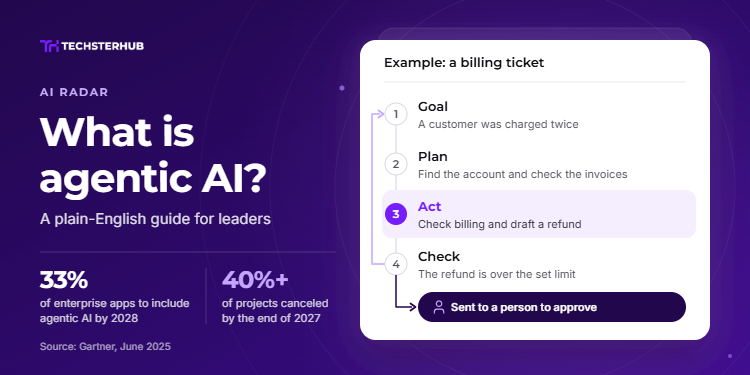
The last question matters more than it used to. Gartner predicts that over 40% of agentic AI projects will be canceled by the end of 2027, citing rising costs, unclear business value, and weak risk controls. A business case that plans for a stop decision reads as more credible, not less.
Start with the problem, not the tool.
Open with one paragraph that describes the business problem and its cost today. “Our support team spends about 12 minutes per ticket, and we expect volume to grow 20% next year without a budget for more hires” is a business problem. “We want to roll out an AI assistant” is not. Agree the baseline numbers with the team that owns them before you write anything else, so finance does not have to question your starting point.
The cost lines most teams miss
License fees are often the smallest part of the total. Use the template below to list every cost over at least two years.
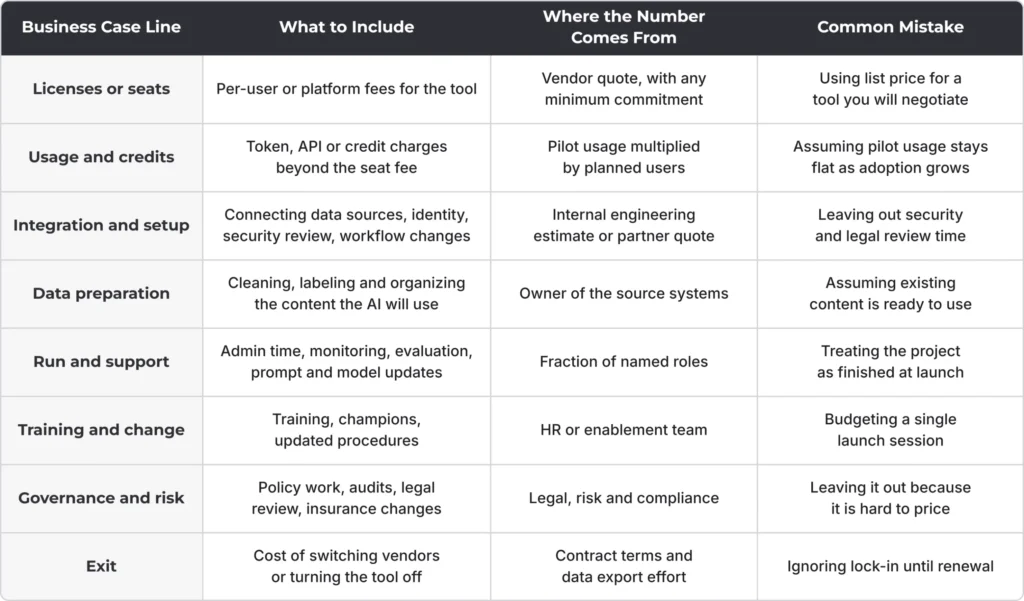
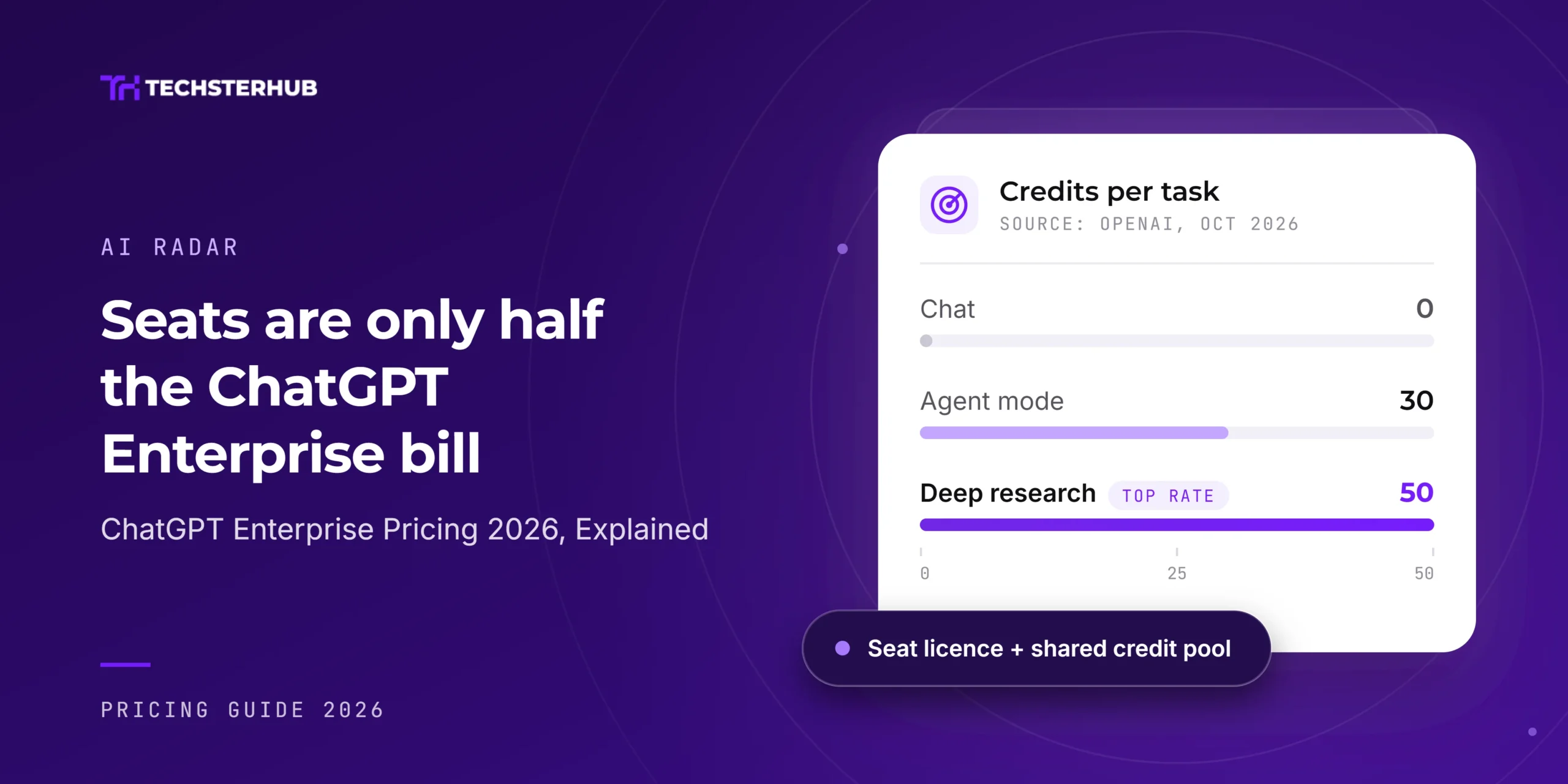
For assistant tools, pricing models are changing quickly, with seats now often combined with usage credits. TechsterHub’s breakdown of ChatGPT Enterprise pricing shows how seats and credits combine in practice.
Value the benefit honestly.
Time saved is the most common AI benefit and the most often overstated. Two minutes saved per task across a team is real capacity, but it only becomes money when the company does something with it. State which of these applies:
- Cost avoided: the team absorbs growth without the hires you would otherwise need.
- Cost reduced: contractor, agency, or overtime spend goes down.
- Revenue gained: faster response or more capacity leads to measurable sales or retention.
- Quality or risk: fewer errors, faster compliance checks, or lower write-offs.
Then apply an adoption factor. Few tools reach full use in the first year. A rate of 60% to 70% of target users in year one is a cautious planning figure until your own pilot data says otherwise.
A worked AI business case example
The figures below are illustrative to show the method. Replace every number with your own data.
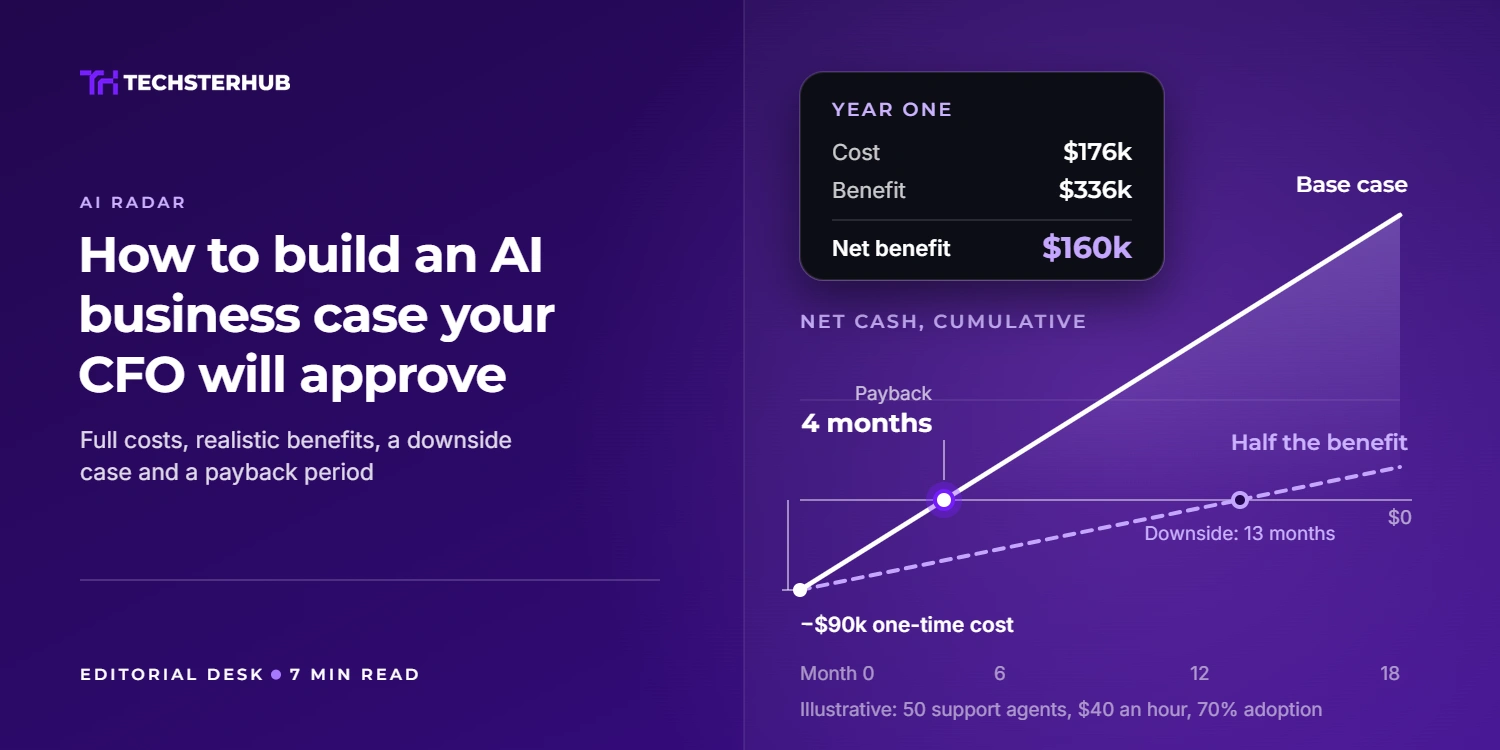
A company has 50 support agents handling about 30,000 tickets a month. A pilot shows an AI assistant cuts average handling time from 12 to 10 minutes. That saves 60,000 minutes, or 1,000 hours, a month, which is 12,000 hours a year. At a fully loaded cost of $40 an hour, that capacity is worth $480,000 a year. With 70% adoption in year one, the planning benefit is $336,000. The company states the benefit as cost avoided, because ticket volume is growing and it will not need to hire.
- Licenses: 50 seats at an assumed $60 a month, or $36,000 a year
- Integration and setup, one time: $80,000
- Training, one time: $10,000
- Run and support, including usage charges and a quarter of an administrator’s time: $50,000 a year
Year one cost is $176,000, so year one net benefit is $160,000. From year two, costs fall to $86,000 a year, and, with the same benefit, the net benefit is $250,000. The recurring cost is about $7,170 a month against a monthly benefit of $28,000, so the $90,000 of one-time cost is paid back in a little over four months once adoption reaches the planned level.
Add a downside case.
Finance will ask what happens if the benefit is lower. Show it before they ask. In the example, if the benefit comes in at half the estimate, $168,000 a year, year one is close to break-even against $176,000 of cost, and year two still returns $82,000. A project that survives its downside case is easier to approve. If yours does not, reduce the scope or the cost before you submit it.
Write the risk section.
Keep the risk section specific and short. Cover:
- Data security: which data the tool can access and how access is controlled
- Compliance: relevant rules such as the EU AI Act, sector regulation, and data protection, with legal sign-off
- Accuracy: how outputs are checked and who is accountable for errors
- Vendor: financial strength, contract terms, data ownership, and exit options
- Adoption: what happens if users do not change how they work
Link these to your company’s AI policy. If one does not exist yet, TechsterHub’s guide to building an AI governance framework covers the basics.
Set milestones that decide the next step.
Replace a single go or no-go decision with staged gates:
- Day 30: adoption above an agreed level and no serious security or accuracy issues.
- Day 90: measured benefit at or above the downside case.
- Day 180: benefit tracking toward the base case, with a decision to expand, hold, or stop.
Each gate names the metric, the owner, and the decision it triggers. This turns the case into a management tool rather than a one-time approval.
Agents need a slightly different case.
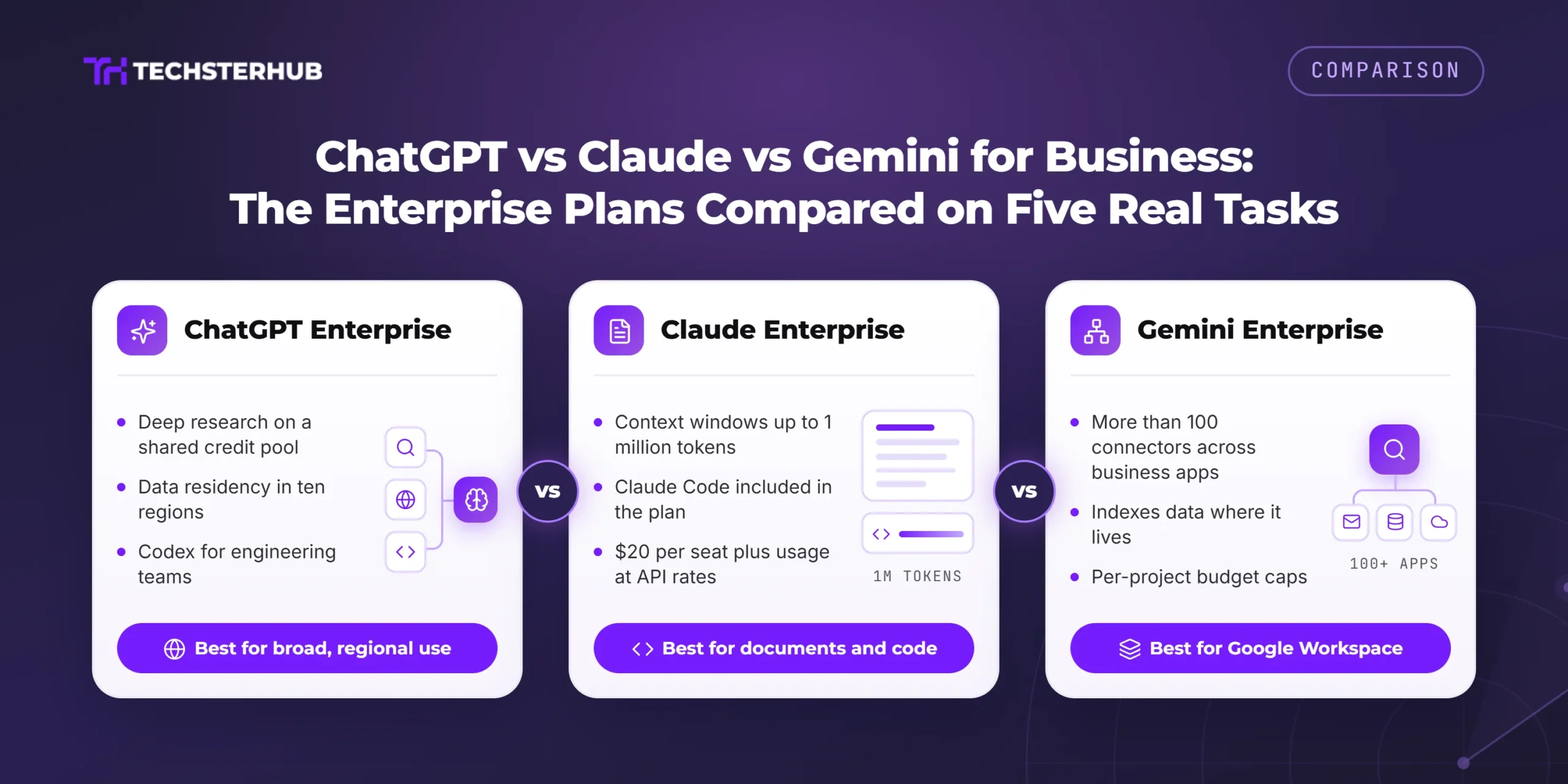
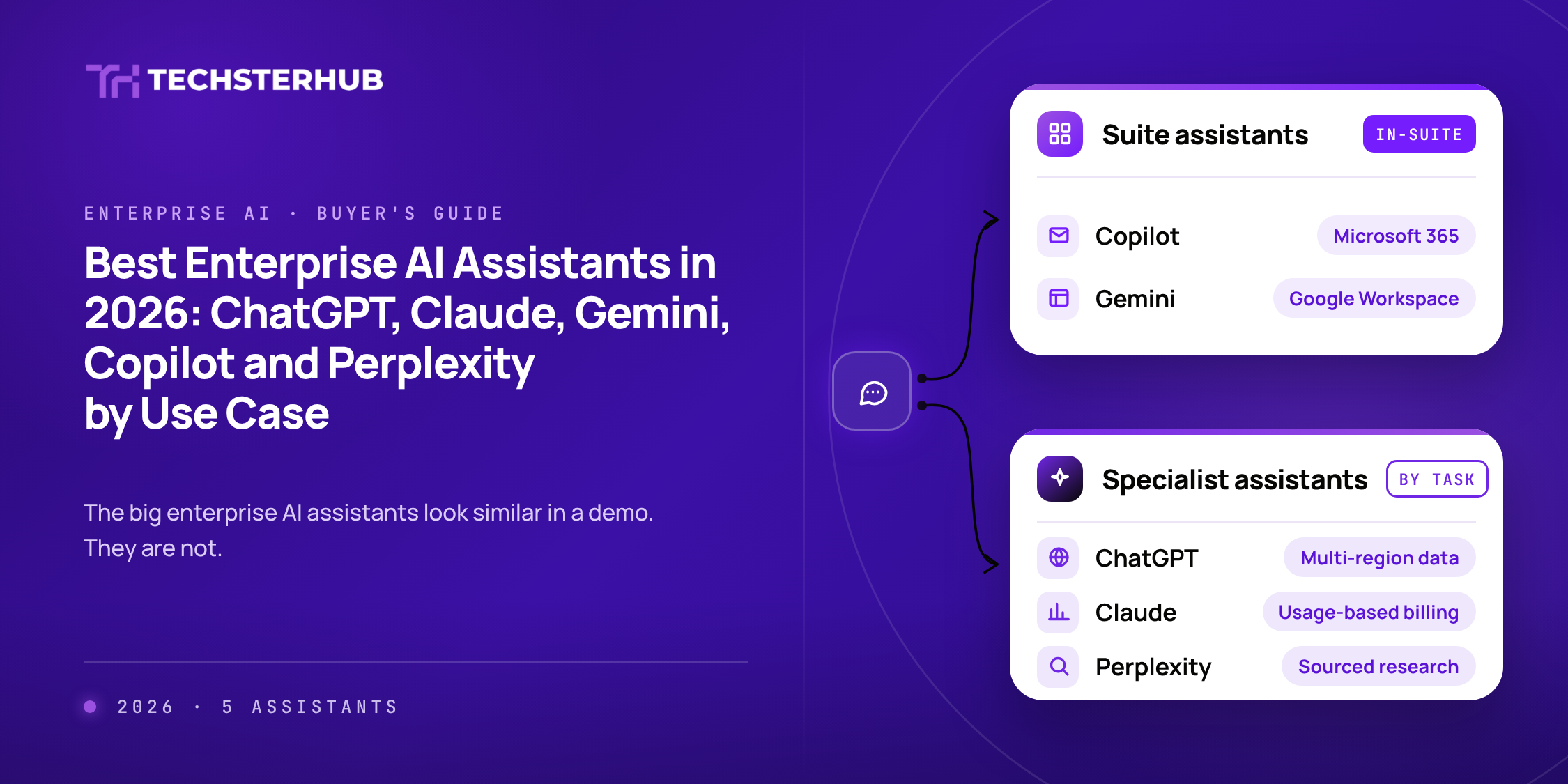
If the project uses AI agents that take actions rather than assistants that suggest them, add three things: the cost of human review for actions the agent proposes, a clear limit on what the agent can do without approval, and the cost of mistakes. Our plain-English guide to agentic AI explains the difference, and our comparison of enterprise AI assistants covers where tools sit today.
FAQs:
What should an AI business case include?
The business problem is in numbers, full two- to three-year costs, a benefit model based on pilot data with realistic adoption, a downside case, a risk section, and milestones that decide whether to continue.
How do you calculate ROI for an AI project?
Subtract total costs from the measurable benefit over the period, then divide by total costs. Value time saved only where it becomes cost avoided, cost reduced, or revenue gained.
What is a good payback period for an AI investment?
It depends on the company’s hurdle rate. Show payback in the base case and the downside case so finance can judge it against other investments.
Why do AI business cases get rejected?
Common reasons are missing costs, benefits counted as cash when they are only freed time, no adoption assumption, no downside case, and no plan for stopping.
Should the business case include governance costs?
Yes. Legal review, policy work, audits, and monitoring are real costs, and finance teams expect to see them.
How is an agentic AI business case different?
It adds the cost of human review, limits on what the agent can do alone, and an estimate of the cost of mistakes.